
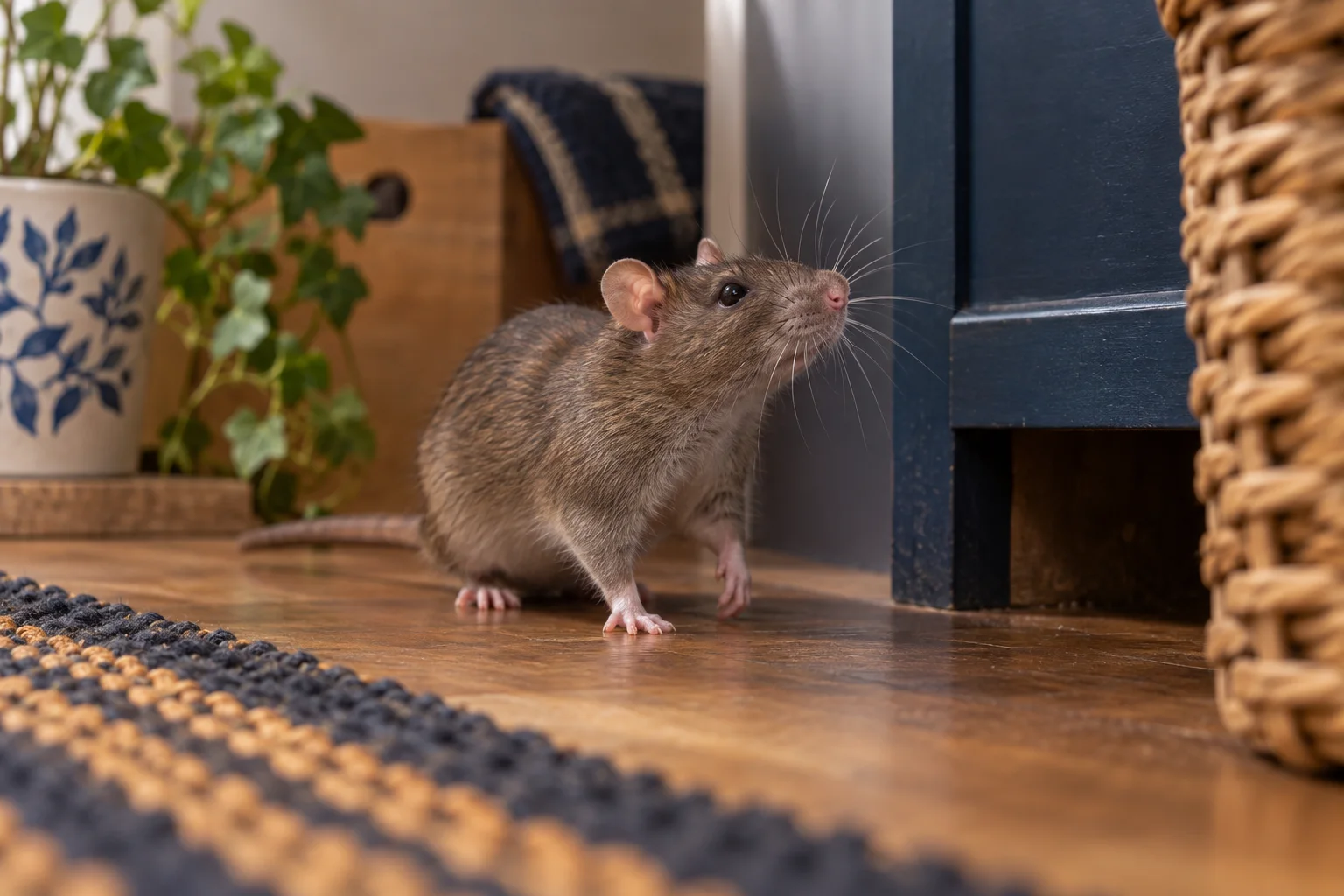
AI-generated illustration
Sound is a clue, not a diagnosis
People often notice a possible rodent problem first as scratching, scurrying, chewing, or thumping after dark. Those sounds can be unsettling, but sound travels through framing, ducts, and ceilings. The loudest point is not necessarily where the animal is, and the animal may not even be a rat. Mice, squirrels, birds, plumbing, HVAC equipment, branches, and building movement can produce noises that overlap with what people describe as rats.
Start by recording the time, duration, room, weather, and whether the noise follows heating, plumbing, or outdoor activity. A short audio recording can be useful, but it rarely identifies an animal by itself. Pair it with physical evidence: droppings, gnaw marks, food damage, a burrow, rub marks, disturbed insulation, or camera footage. That approach avoids cutting into a wall or applying pesticide in response to an uncertain sound.
Common audible noises around a building
Rats can make audible movement sounds as they run over ceilings, travel through wall voids, or disturb dry material. Gnawing can sound like scraping or repetitive tapping. Nesting activity can rustle insulation, paper, or stored items. During close encounters, rats may also make audible squeaks or distress sounds. The exact noise changes with the space: a small animal on a metal duct can sound much larger than it is, while movement in soft insulation can be barely audible.
Timing supplies context. Rats are mostly active at night, according to UC IPM, so repeated activity after dusk can support a rodent hypothesis. It does not prove it. Daytime construction noise, a branch rubbing siding, or a malfunctioning appliance can still occur at any hour. Treat a schedule as one data point. The useful question is whether the noise pattern matches fresh signs and an accessible route.
Much rat communication is outside human hearing
Laboratory and biological research shows that rats emit ultrasonic vocalizations, including calls commonly discussed around 22 and 50 kilohertz. These frequencies are above normal human hearing, so a person should not expect to hear every rat communication sound. Young rats can also produce calls in different contexts than adults. The science is useful for understanding social behavior, but it does not turn a phone recording or consumer sound app into a reliable infestation test.
An audible chirp, squeak, or clicking noise is therefore not automatically a rat vocalization. It may be a bird, insect, appliance, pipe, or another mammal. Do not use a claimed frequency from an app as proof of species. A practical inspection relies on visible evidence and conditions that make a route plausible, then uses sound only to decide where and when to look more closely.
Separate gnawing from building sounds
Rodents gnaw, but not every repetitive sound is teeth. Wood can expand and contract, pipes can tick as they change temperature, and ducts can transmit vibration. A professional should inspect an area for actual tooth marks, damaged packaging, shredded material, or entry gaps before deciding that gnawing is taking place. Rat tooth marks are generally larger than mouse marks, yet size alone can be distorted by the material and angle.
If a sound seems to come from an outlet, appliance, ceiling, or electrical area, do not open covers or reach into the space while energized. Damaged wiring is a safety issue that may require a qualified electrician. A pest professional can document rodent evidence, but they should not represent electrical repair as a casual add-on. Solving the sound may require both accurate animal control and building repair.
Use a quiet observation plan
Choose a safe time to look for supporting signs. Check food storage, along walls, around utility rooms, near garages, and outside around garbage, compost, or foundation shelter. Do not sit in a dark attic or crawlspace to listen, and do not block vents or holes while trying to force an animal into view. A motion camera placed safely along a suspected route can supply better evidence than repeated anxious listening.
Keep a map of sounds and signs. Mark a sound as unconfirmed unless there is independent evidence. This distinction is valuable if the noise stops after a plumbing repair or begins after wind damage: it keeps the diagnosis open. Where the evidence does support rats, use an integrated plan of food management, exclusion, monitored removal, and follow-up rather than treating the sound itself as the problem.
When to involve a professional
Arrange professional help if sounds are persistent, the suspected area is inaccessible, wiring is damaged, contamination is extensive, or the building is shared. Ask the inspector what evidence confirms rodents and what other explanations were considered. A good answer acknowledges limits. No one can identify an animal with certainty from a vague scratch alone, and an honest report will say when more monitoring is needed.
Once a route is identified, repair it with materials appropriate to the assembly and preserve ventilation and drainage. CDC recommends traditional snap traps for rodents and advises against glue traps and live traps. Monitor after repairs rather than assuming a quiet night is final proof. The goal is not to memorize animal noises; it is to use a sound as the first clue in a process that finds and changes the conditions behind it. A useful record can also show whether sound occurs after particular equipment runs or follows a route that later produces physical signs. That connection is stronger than either type of observation alone and can save an unnecessary opening in a finished wall.