
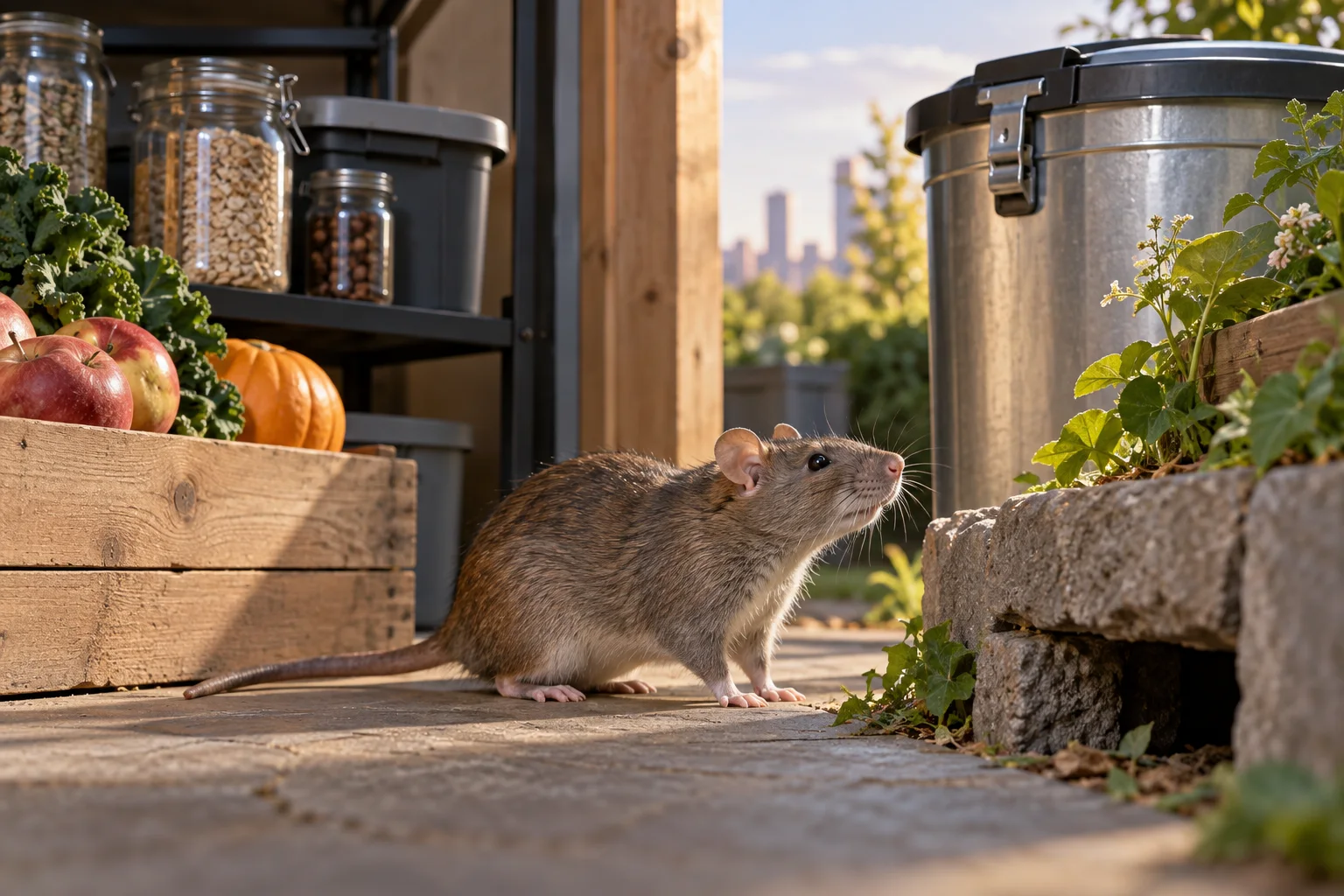
AI-generated illustration
Rats are not one ecological story
“Rat” is a common name applied to many kinds of rodents, and the animals near a house are not automatically the same as the native species in a nearby woodland, desert, or park. In North America, Norway rats and roof rats are commensal species: they live in association with people and are introduced in many places. Woodrats, also called packrats, are native species in many regions and have different habitats, conservation concerns, and relationships with people.
That distinction matters when asking why rats exist. An animal’s ecological role cannot be reduced to the damage caused by a different species in a pantry. UC IPM identifies roof rats and Norway rats as common urban pests, while the National Park Service describes the Allegheny woodrat as a native North American animal whose populations have declined across parts of its historic range. Names that sound similar do not settle the conservation or management question.
Rodents occupy basic places in food webs
Rodents consume plant material, seeds, fruits, insects, carrion, or other available food depending on the species and habitat. In turn, they are prey for many other animals. The National Park Service notes that rodents are an important food source for hawks, owls, coyotes, foxes, bobcats, and weasels. This is not an argument that a household infestation should be ignored; it explains why rodent populations are connected to the larger web of predators and resources around them.
Some native woodrats have roles beyond feeding predators. The National Park Service reports that woodrats spread seeds and build structures that other animals use as shelter. Seed caching, browsing, gnawing, and nest building can alter where plant material and shelter occur. The precise effect depends on species and place. Ecology is therefore a description of relationships, not a moral ranking of animals as useful or useless.
Evolution favors flexible survival strategies
Rats and other rodents have persisted because their bodies and behavior fit many changing environments. Incisors that continue to grow support gnawing, and rodents wear those teeth through use. NPS explains that the enamel arrangement of rodent incisors helps maintain a sharp chisel-like edge. Different rodent species then specialize in different foods, shelter, and movement patterns, from climbing and seed caching to burrowing and swimming.
The species that thrive around buildings also benefit from behavioral flexibility. UC IPM describes rats as exploring and learning their surroundings, remembering routes to food, water, and shelter, and showing caution around unfamiliar objects and foods. Those traits are not a plan to annoy homeowners; they are survival traits that become especially effective where human settlements offer dependable resources and protected spaces. The same adaptability that makes an animal hard to trap can be ecologically ordinary.
Human landscapes create a particular niche
Cities, farms, warehouses, sewers, gardens, and homes concentrate food, water, warmth, cover, and travel corridors. A roof rat can use shrubs, fences, branches, and upper building features; a Norway rat can use ground-level cover, burrows, and utility infrastructure. When garbage, pet food, fallen fruit, leaks, storage clutter, and entry gaps coexist, people have unintentionally assembled the parts of a useful habitat.
This is why the question changes near a home. The fact that rodents belong in ecosystems does not require a resident to share a kitchen, attic, or electrical system with an introduced commensal rat. UC IPM documents food contamination, gnawing damage, and risks to property around structures. Humane, responsible household management can recognize ecological reality while preventing access to a building. Respecting wildlife does not mean ignoring a damaged vent or an active nest in insulation.
Native conservation and home control can coexist
A homeowner should avoid assuming every rat-like animal is a Norway rat or roof rat. A woodrat’s furry tail differs from the mostly hairless, scaly tail of the common commensal rats, according to UC IPM, but distance, lighting, and age can still make identification uncertain. Local wildlife rules and conservation status may matter for native species. If an animal might be a protected or unfamiliar species, use local wildlife guidance rather than treating it as a routine indoor pest by default.
At the same time, a building should not be left open while an identification debate continues. Secure food, avoid handling droppings, inspect access points, and obtain professional or agency guidance suited to the animal and location. The repair of a door sweep or pipe gap is sensible regardless of species. Species identification becomes more important when deciding how to handle a live capture, nest, or wildlife conflict.
A useful answer stays specific
Rats exist because evolution has produced many rodent species that survive through feeding, reproduction, movement, and interaction with other organisms. In natural habitats, native rodents can disperse seeds, build shelter structures, and support predators. Around homes, introduced commensal rats can take advantage of human-made food and shelter, and their presence can damage property and contaminate food. Both statements can be true without pretending every rat species has the same role. Species, habitat, and location are the details that make the answer useful.
For a homeowner, the practical response is to focus on the setting. Remove accessible food and water, reduce cover, close entry routes, and respond safely to evidence inside the structure. That manages the conflict at the house without turning a real pest problem into a claim that an entire order of animals has no place in the world.