
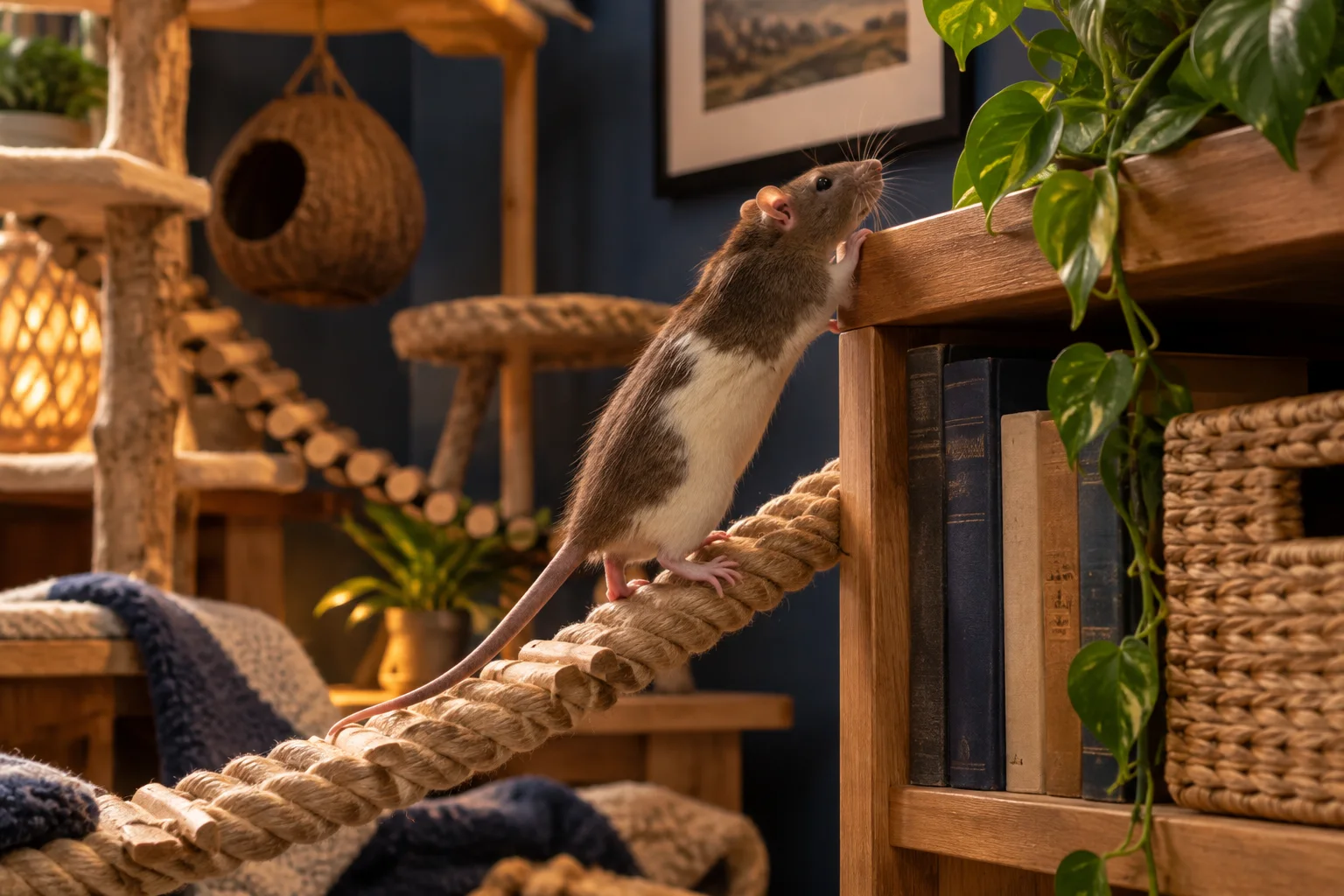
AI-generated illustration
Rats can reach much more than the ground floor
Rats are not limited to ground-level holes. UC Integrated Pest Management notes that roof rats are agile climbers that travel on overhead utility lines and fence tops, and it distinguishes their upper-level habits from the more ground-oriented Norway rat. That difference matters when a homeowner hears activity in an attic, finds gnawing near an eave, or sees signs high on a wall. An inspection that stops at the foundation can miss the route entirely.
Do not try to name the species from a single sound or a distant glimpse. Use the behavior as a reason to inspect the whole route to the building: landscaping, fence lines, pipes, cables, rough walls, roof edges, and vents. A rat’s ability to climb does not mean every branch or wire is an active access path. The useful task is to find physical connections that lead from cover to an opening, then confirm those areas with fresh evidence.
Common climbing routes around a house
Trees, vines, shrubs against siding, fences that meet the building, stacked materials, downspouts, pipes, rough masonry, and overhead utility lines can all help create a route toward a roof or upper wall. A route may be made of several small connections rather than one dramatic jump. For example, dense vegetation can conceal travel along a fence, a branch can reach the roofline, and a loose soffit screen can provide the final entrance. Look for the entire chain rather than only the point where the animal enters.
Roof rats are especially associated with elevated travel, but a home should be checked for both high and low access. UC IPM describes Norway rats as generally more burrowing and ground-oriented, while roof rats may nest in trees or attics. Those are useful patterns, not a remote diagnosis. Ground burrows, damaged lower vents, and an overhead route can exist at the same property, so prevention needs to address the evidence that is actually present.
Inspect elevated areas safely
Begin from the ground with binoculars, a phone camera zoom, or a bright flashlight used from a stable position. Look for damaged or displaced vent screens, gaps below eaves, loose soffit material, openings around roof penetrations, branches touching the structure, and vines that hide wall defects. Check where service cables, conduit, air-conditioner lines, and pipes approach the home. Photograph anything that needs a closer inspection so a professional can see the location before accessing it.
Do not climb onto a roof, lean from a ladder, or work near energized power lines to chase a suspected rat route. If branches are close to utility service, contact the utility company or a qualified tree professional rather than pruning around lines yourself. A rodent issue does not justify creating a fall or electrical hazard. Good inspection separates what you can document safely from work that needs the equipment, training, or authority of another professional.
Prune and clear access thoughtfully
Landscaping can make a home easier for rats to approach unseen. UC IPM recommends keeping overhanging limbs away from roofs and thinning dense climbing vegetation near buildings. That helps reduce direct access while also making the exterior easier to inspect. Prune in a way that preserves the health and safety of the plant and complies with local rules. Do not remove a mature tree or strip all vegetation solely because a rat was seen nearby; first identify the actual route and building entry point.
Remove vines or shrubs that cover foundation gaps, utility penetrations, and low vents, then look at the structure behind them. Move woodpiles, ladders, bins, and stored items that create a step-up beside the wall. The goal is a visible, maintainable perimeter. A clear exterior lets you spot fresh gnawing, rub marks, damaged screens, and new openings before an animal reaches an upper-level feature. It also prevents a landscaping choice from becoming an unnoticed bridge to the roof.
Repair the final entry point
Cutting off one climbing route is not enough if a roof vent, soffit, chimney opening, or utility gap remains open. UC IPM recommends sealing cracks and openings around pipes, wires, sewer pipes, drain spouts, and vents, and it emphasizes that upper-level openings need attention where roof rats are a concern. Inspect doors, windows, and screens as well. A rat that loses a tree route may still use a garage edge, a utility penetration, or a ground-level opening you overlooked.
Choose a repair that matches the building feature. A durable screen, fitted metal barrier, or sound patch may be appropriate, while an improvised bundle of soft material may not last. Do not alter a chimney, combustion vent, dryer vent, or other system without understanding the safety and code requirements. A roofer, HVAC technician, electrician, or pest-exclusion professional may be needed for the final detail. The repair should keep rodents out without stopping the feature from doing its intended job.
Verify that the route is no longer in use
After clearing access and completing repairs, check the same locations over time. Look for new gnawing at edges, a damaged screen, fresh droppings in sheltered areas, rub marks along beams or pipes, or repeat noise in the same part of the structure. Record dates and locations instead of relying on memory. A quiet night is encouraging but does not prove that every access point has been addressed, especially when activity can occur outside your normal observation hours.
If signs continue, revisit the route from the outside inward: nearby cover, climbing connection, roofline or wall opening, then the interior area where evidence appears. Ask a qualified professional to inspect inaccessible rooflines, attics, or utility-adjacent locations. This method is more reliable than using scent products or placing a single trap near where you heard a noise. Rats can climb in many ways; the homeowner’s advantage comes from removing the connected route and maintaining the building envelope.