
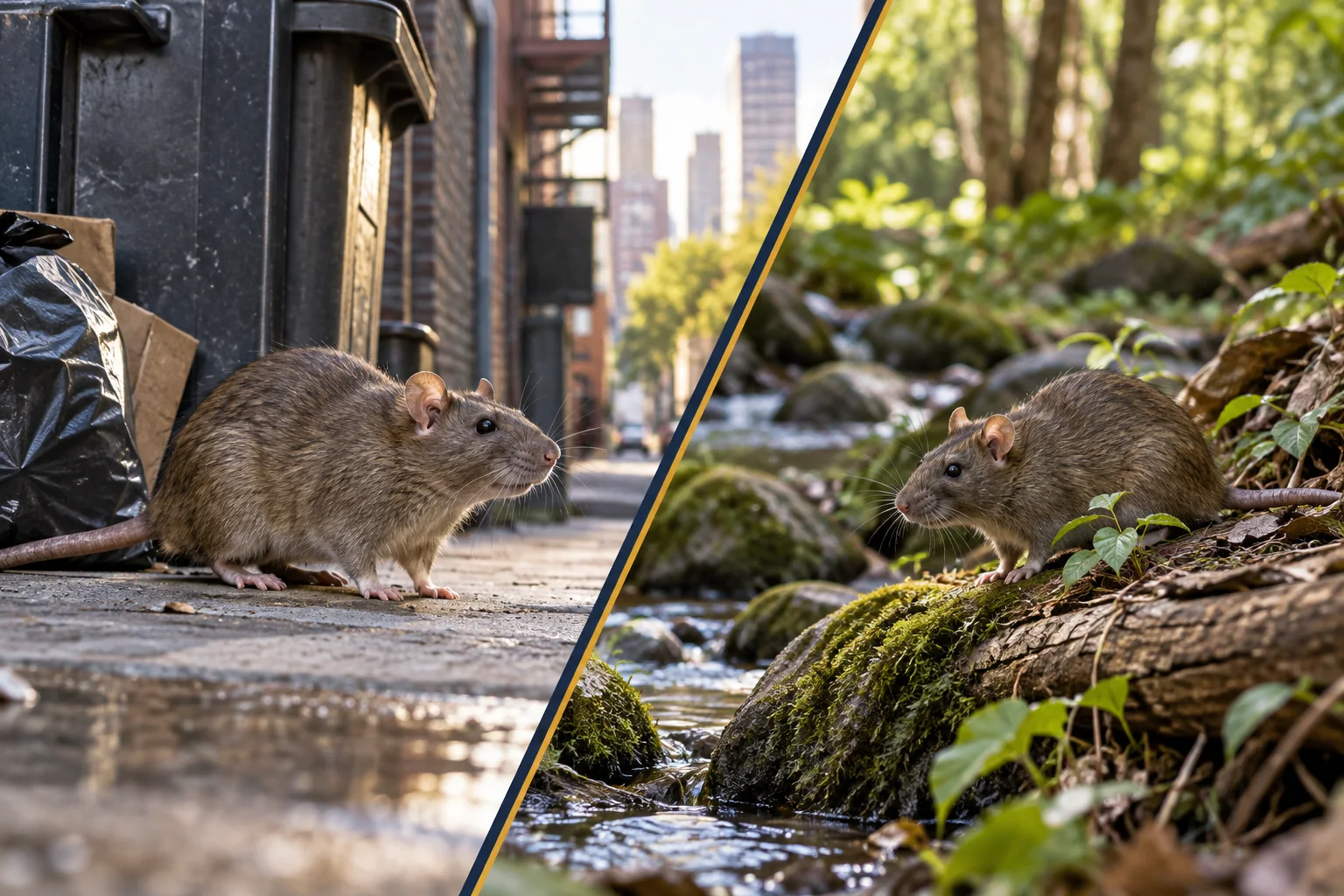
AI-generated illustration
Rats follow resources rather than a city label
Rats are strongly associated with cities because dense development can provide abundant food, shelter, warmth, and connected routes. But cities are not their only habitat. Commensal rats can live around farms, barns, grain storage, animal feed, rural homes, waterfronts, warehouses, campgrounds, and small towns. Whether an area is urban or rural matters less than whether it offers dependable food, water, cover, and safe movement between them.
A rural property can seem far from a city yet support rats through spilled feed, unsecured garbage, compost, livestock areas, woodpiles, dense vegetation, outbuildings, and gaps in a house or barn. An urban block can have low activity when food waste is contained, cover is managed, and building entries are maintained. Avoid treating rat activity as proof that a place is uniquely dirty or inherently urban. It is a response to conditions that can be inspected.
Different settings emphasize different routes
Norway rats are generally stocky burrowing rats. UC IPM notes that they commonly build burrows along foundations, beneath trash piles, or in woodpiles, and indoors they tend toward basements or ground floors. Roof rats are more agile climbers and can use trees, utility lines, fences, and upper building routes. Both kinds can appear in developed and less-developed settings where the local conditions match their abilities.
In a city, an inspection may begin with refuse enclosures, sidewalk defects, basements, service penetrations, and shared building routes. In a rural setting, it may begin with feed rooms, barns, equipment sheds, stored seed, outbuilding doors, exterior clutter, and vegetation against the structure. These are starting points, not rules. The right inspection follows fresh signs and the actual path between an animal's shelter and food.
Wild habitat and commensal behavior are not identical
People sometimes use the word rat for native rodents as well as the non-native commensal rats that frequently use human structures. Native woodrats, for example, have different biology and may have different legal status from Norway or roof rats. UC IPM notes that woodrats can be distinguished from common commensal rats by their furry tails, while the latter have scaly, mostly hairless tails. Do not assume every rodent in a rural area is a pest rat.
If the species is uncertain, observe from a distance and preserve photographs rather than handling the animal. Local extension, wildlife agencies, or qualified professionals may be able to guide identification and lawful response. This is especially important where a nest, dependent young, or protected wildlife may be involved. A tailored response begins with knowing what animal is present and what conditions bring it close to people.
Prevention works in both landscapes
Store food, feed, seed, and garbage in durable containers; clean spills; repair water leaks; manage compost; remove unnecessary clutter; and maintain doors, vents, utility openings, and structural repairs. In rural properties, keep feed rooms and outbuildings orderly and inspect stored equipment before use. In urban properties, coordinate with neighbors or management when garbage, shared basements, courtyards, or adjoining structures are part of the route.
Do not block a drain, air intake, required vent, or animal passage without understanding the building function and applicable rules. Exclusion should use durable materials suited to the structure and should be coordinated with removal. Sealing an active route without accounting for animals inside can create problems in walls or attics. Recheck repairs after weather, construction, and seasonal changes.
Control should fit the setting and species
For confirmed indoor activity, CDC recommends traditional snap traps and advises against glue traps and live traps. Use commercial traps sized for the animal and placed in protected, monitored locations. Rodenticides have label and non-target safety requirements; they are not a universal rural shortcut. On farms, around pets, and near wildlife, the consequences of poorly controlled bait can be significant.
The best evidence of success is repeated absence of fresh signs after food access, shelter, and entry conditions are corrected. This applies whether the property is downtown, suburban, or remote. Rats do not choose a setting because of its label. They choose a workable system. Changing that system is more reliable than treating urban and rural rat problems as separate mysteries.
Plan for seasonal changes in a working landscape
Harvest, feeding changes, moving stored equipment, winterizing buildings, landscaping, and construction can expose routes that were hidden. Water can also determine whether a route remains useful: outdoor leaks, irrigation, animal watering areas, clogged drains, and equipment condensation deserve attention in both cities and rural properties. Correcting a leak protects the structure as well as reducing a resource.
If rats are confirmed in an outbuilding, do not move contaminated nesting material into the home or burn it casually. Follow appropriate cleanup and waste guidance, then inspect the next building on the route. Compare feed storage, water points, vegetation, and access gaps across connected sheds rather than treating each one alone. A final inspection should include the structure and surrounding storage because an overlooked feed source or access point can restart activity in either landscape, season, or nearby property with connected cover and unprotected feed storage.